


One bag, one seal, done.

Close the lid, turn the dial, lift away a welded bag.
Vacuum sealer
A pump draws the air out of the bag and a heated bar welds the mouth shut — so the steaks you portion on Sunday come out of the freezer months later looking the way they went in.
Pull the air out. Keep the colour in.
Lay the bag across the seal bar, close the lid, turn the dial — the pump draws the plastic tight around the food and a heated bar welds the mouth shut.
Takes any 11-inch bag
One dial, one button
1-year warranty
Couldn't load pickup availability


How it works
Air against the surface is what turns frozen meat grey and leathery. The pump removes the air; the heated bar welds the bag shut behind it.
The pump draws the bag tight against the food and holds it there while the bar seals the mouth. What reaches the freezer is meat with the air already gone — which is the thing that dries it out.
Break the bulk pack down on Sunday, seal each cut flat, and stack the freezer upright like files. Portions come out one at a time, each in its own sealed bag.
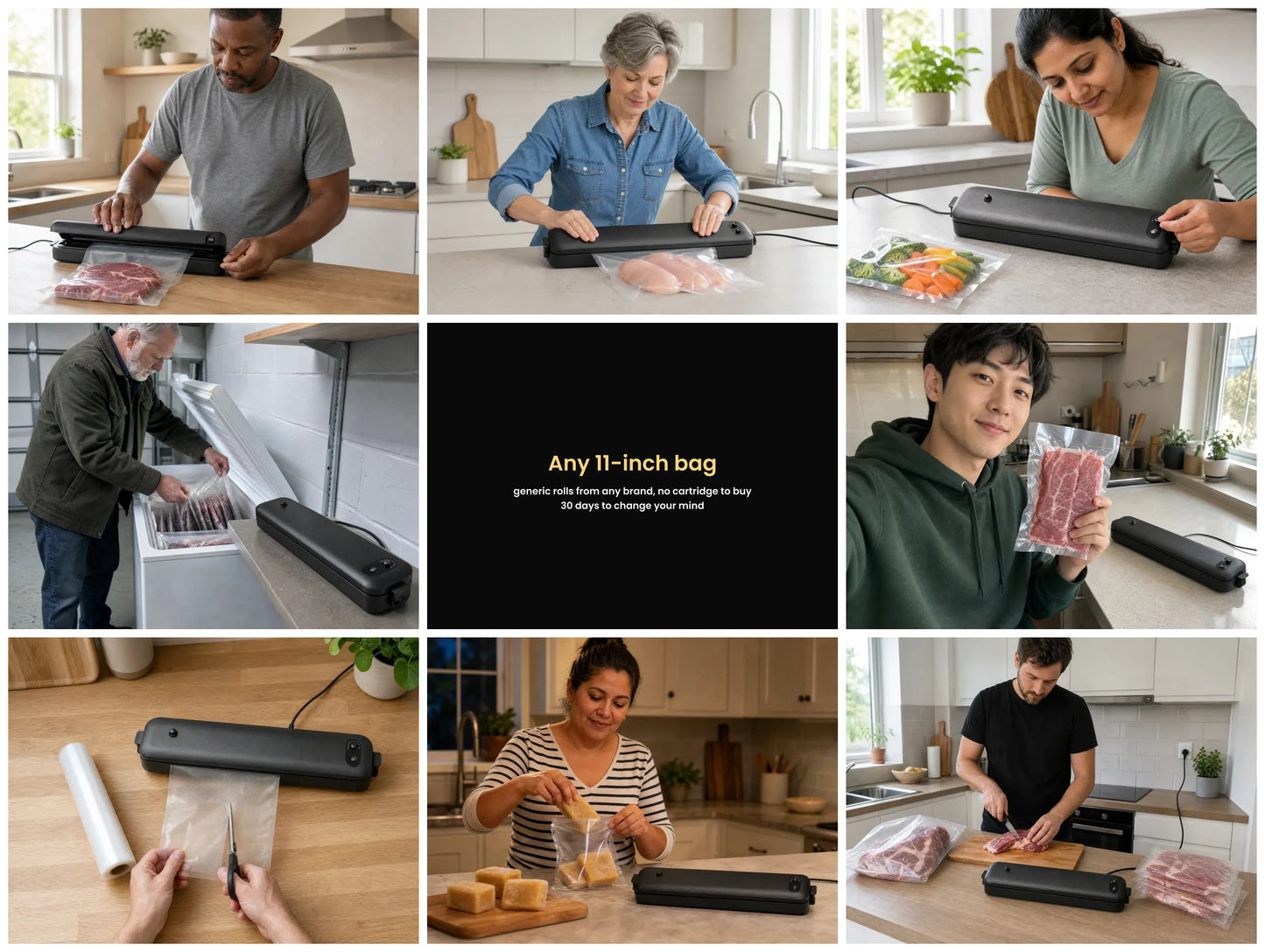
It takes generic pre-cut bags and rolls from any brand up to 11 inches wide — the kind stocked at any supermarket. The machine leaves you free to buy whichever bag is cheapest that week.
Before you buy
Close the lid, turn the dial, lift away a welded bag.

The grey edges and ice crust come from air — and the air is gone.

Generic pre-cut bags and rolls, any brand, up to 11 inches wide.

The whole control panel, on a machine the size of a rolling pin.

Freeze it solid first, then seal — flat blocks that stack.

Sealed bags stand upright in rows you can actually read.
Why choose it
Freezer burn is air against the surface of the food. The pump takes the air out; the weld keeps it out.

The warehouse pack becomes a row of flat, sealed portions in one sitting at the counter.

Pre-cut bags and rolls from any brand up to 11 inches — stocked at any grocery store, priced like a commodity.

Turn it, press the button, wait for the weld. There is nothing else to learn on it.

Flat sealed bags file upright like folders — you see every cut you own at a glance.
Half the pack goes grey before you eat it.
Air is what does that.
This pulls the air out and welds the bag shut.
Sunday’s steaks come out looking like Sunday.
Straight comparison
The honest version: each route is good at something. Here is where they actually differ.
| Critério | Vacuum sealer | Zipper bag | Foil + film |
|---|---|---|---|
| Air around the food | Pumped out, bag drawn tight | Pressed out by hand, some stays | Trapped in every fold |
| The grey, dried edges | The cause leaves with the air | Arrive sooner | Arrive sooner |
| What you buy again | Generic bags, any brand to 11 in | A new box of zippers | Foil and film |
| Soup and marinade | Freeze solid first, then seal | Pour straight in | A wrap cannot hold liquid |
| Stacking in the freezer | Flat bags, filed upright | Slumps into lumps | Odd shapes pile up |
| The seal itself | Welded shut by a heated bar | A zipper that can reopen | Held by a tuck or tape |
Swipe the table to see every column →
Based on how each method handles air, which is what dries frozen food out. We do not claim lab results we have not run.

Plain terms
Each seal uses one bag, the bags are single-use, and they are sold separately — there is no bag in the box. The machine takes generic pre-cut bags and rolls from any brand up to 11 inches wide, the kind stocked at any grocery store, so the running cost is the shelf price of a commodity bag rather than a branded refill.
And it is a bar sealer, not a chamber machine: the pump pulls air, and free liquid would follow the air into the pump. Soup, stock and marinade go in the freezer first and get sealed as solid blocks. Rolls wider than 11 inches do not fit.
Specs
From customers

As a busy mom, FreshPak Vacuum Sealer is a game-changer! It simplifies meal prep, seals perfectly, and preserves food's quality like a pro. Highly recommend!
Rachel M.

FreshPak Vacuum Sealer's compact design fits perfectly in my kitchen. It's so easy to use, and the results are impressive. A smart investment for sure!
Charles S.

I couldn't be happier with FreshPak Vacuum Sealer! It keeps my food fresh and tasty, saving me money and reducing waste. A must-have for any kitchen!
Madison W.
No lock-in
The machine is the only thing you buy from us. The bags it runs on are generic, sold in every grocery store, priced like the commodity they are — whichever brand is cheapest that week is the right one.
11 in
Takes generic pre-cut bags and rolls from any brand
1 dial
The whole control surface — turn it, press the button
1 year
Covered against defects, with both shipping legs on us
Before you buy
Generic vacuum-sealer bags — pre-cut or rolls — from any brand, up to 11 inches wide. They are stocked at most grocery and hardware stores and online. The machine has no brand lock: whichever bag is cheapest works.
No — bags are sold separately, and each seal uses one bag. They are single-use. Budget for bags the way you budget for freezer paper: a running cost, priced like a commodity because any brand fits.
Freeze it solid first, then seal the frozen block. This is a bar sealer: the pump pulls air, and free liquid would follow the air into the pump — which the warranty treats as liquid damage rather than a defect. Frozen flat blocks also stack far better.
Air against the surface of the food. The moisture leaves the food and the surface dries into the grey, leathery patches and the crust of ice inside the bag. Sealing removes the air, which removes the cause.
Airtight and frozen, meat holds its colour and texture for months rather than weeks. We are not going to print a bigger number than that: how long depends on the cut, the freezer and the seal, and the honest answer is a range, not a promise.
If it fails in the first year, that is the warranty: a replacement unit, with the return label and the outbound shipping both paid by us. You need the order number, nothing else.
Send it back within 30 days for a refund of the product price. On a change of mind the return postage is yours. If it arrives faulty, that is the warranty instead, and we pay the shipping both ways.
1-year warranty · 30-day returns
Seal a week of portions, stack them flat, and pull one out next month. If the machine does not earn its spot on the counter, send it back within 30 days for a refund of the product price.
Free US shipping · secure checkout